
What Happens If the Other Driver Is Uninsured in Las Vegas? Your Legal Options Explained
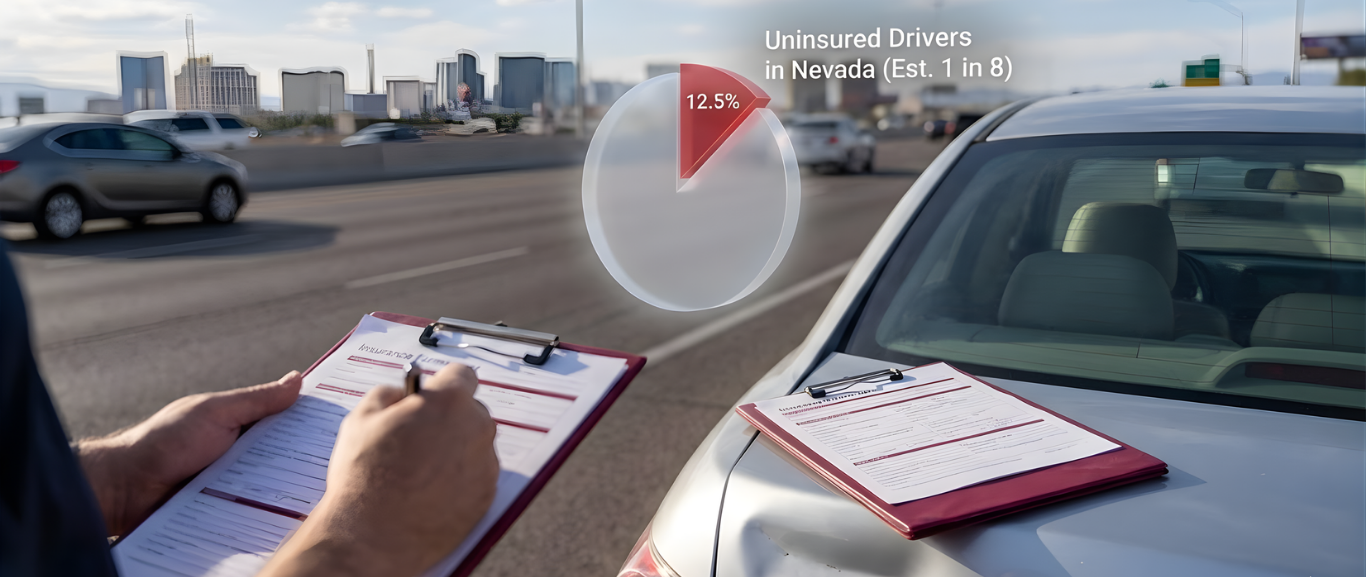
Nevada ranks among the top 10 states in the country for the number of uninsured drivers. About 1 in 8 drivers on Nevada roads carries no insurance at all. If you were just hit by one of them on the I-15 or in a parking lot off the Strip, you may be wondering whether you’re simply out of luck. You’re not. But your options depend on a few things including the coverage you carry and how quickly you act.
This page answers exactly what happens if the other driver is uninsured in Las Vegas. We’ll cover Nevada’s insurance rules, how uninsured motorist coverage works, whether suing the at-fault driver personally makes sense, and what to do if your claim gets denied. By the end, you’ll know your next step.
What Happens If the Other Driver Is Uninsured in Las Vegas?
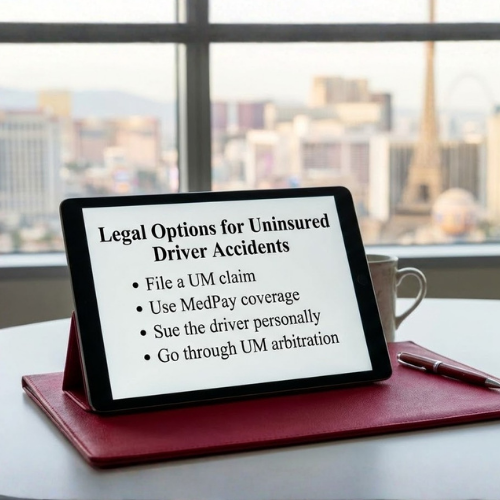
If the at-fault driver has no insurance in Las Vegas, you still have legal options. Here’s what typically applies:
- File a UM claim — If you carry uninsured motorist (UM) coverage in Nevada, your own insurer pays for your injuries and damages.
- Use MedPay coverage — Nevada MedPay covers your medical bills regardless of who was at fault.
- Sue the driver personally — You can file a civil lawsuit against the uninsured driver, though collecting a judgment can be difficult.
- Go through UM arbitration — If your insurer disputes your claim, Nevada law may require arbitration before the case can move to court.
The right path depends on your specific coverage and the severity of your injuries.
Nevada’s Car Insurance Requirements And Why Gaps Still Happen
Nevada law requires every driver to carry liability insurance before getting behind the wheel. The minimum coverage amounts are set under NRS 485.185.
| Coverage Type | Nevada Minimum | What UM/UIM Adds |
|---|---|---|
| Bodily injury (per person) | $25,000 | Covers you when the at-fault driver can't |
| Bodily injury (per accident) | $50,000 | Fills the gap when their limits run out |
| Property damage | $20,000 | UM typically does not cover this — check your policy |
Despite these requirements, roughly 1 in 8 Nevada drivers is uninsured at any given time. That number stays high for several reasons. Some drivers let their policies lapse after missing a payment. Others move to Nevada from out of state and haven’t updated their coverage yet. Some simply can’t afford the premiums and take the risk. When an uninsured driver is caught, the penalties under NRS 485.187 are real fines, license suspension, and possible vehicle impoundment. But those penalties don’t put money in your pocket after a crash.
In our experience handling Las Vegas accident cases, most uninsured drivers we’ve seen didn’t set out to break the law. A missed payment or a lapsed renewal is the most common cause, not intentional fraud. That distinction matters when you’re deciding whether to pursue the driver personally or rely on your own coverage. Knowing why gaps exist helps. But what matters more right now is whether you have protection in place and how to use it.
What Is Uninsured Motorist Coverage and How Does It Work in Nevada?
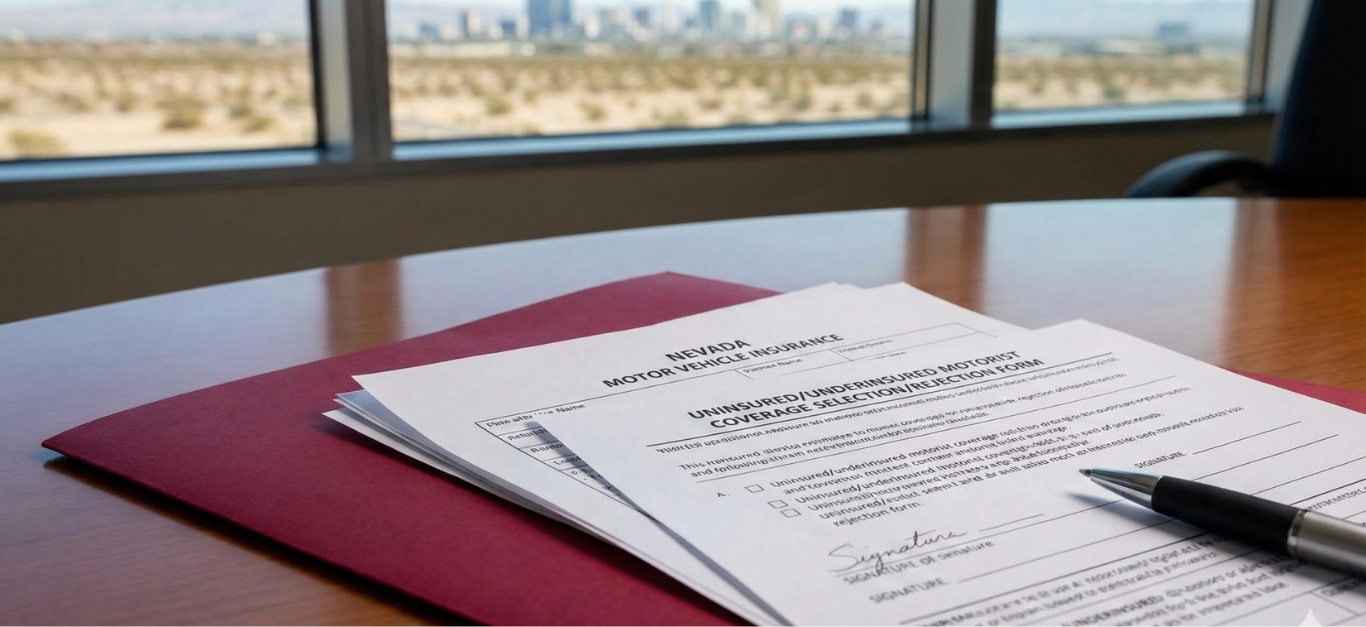
Uninsured motorist (UM) coverage means your own insurance company steps in when the at-fault driver has no insurance. Underinsured motorist (UIM) coverage works similarly; it applies when the other driver has insurance, but their policy limits aren’t enough to cover your losses. Under NRS 687B.145, Nevada insurers are required to offer UM/UIM coverage to every policyholder. But you are not required to accept it. If you signed a written rejection form at any point, even years ago, you may not have this coverage today. Before assuming you’re protected, pull your declarations page and confirm.
Here’s a quick comparison of your first-party coverage options:
| Coverage | What It Covers | When It Applies |
|---|---|---|
| UM | Medical bills, lost wages, pain, and suffering | The at-fault driver has no insurance |
| UIM | Same as UM — fills the gap | At-fault driver's limits are too low |
| MedPay | Medical bills only | Regardless of fault, pays first |
MedPay is a separate coverage type that pays your medical bills directly, no matter who caused the crash. It’s not a replacement for UM coverage, but it can help cover treatment costs while your UM claim is still being processed. One thing UM coverage often does not cover is property damage to your vehicle. For that, you’d typically need collision coverage. Always read your declarations page carefully.
We’ve seen clients who were certain they had UM coverage only to find they had signed a rejection form years earlier without realizing it. Checking now, before you need it, takes five minutes. But what if you don’t have UM coverage at all? You may still have another option: going after the driver directly.
Can You Sue an Uninsured Driver Personally for Damages in Nevada?
Yes. Nevada law allows you to file a personal injury lawsuit directly against an uninsured at-fault driver. You don’t need to have UM coverage to pursue this option. But before you go this route, it’s worth understanding what you’re likely walking into. The biggest practical challenge is collecting on a judgment. Many uninsured drivers have no significant assets, no real property, and limited income. Even if you win in court, a judgment against someone with nothing to collect from is difficult to enforce. Lawyers call this being “judgment-proof.” Under NRS 11.190, you have two years from the date of the accident to file a personal injury lawsuit in Nevada. Missing that deadline means losing your right to sue, regardless of how strong your case is.
A personal lawsuit is worth pursuing when the at-fault driver has something to collect from. Ask these four questions before deciding:
- Does the driver own real property in Nevada?
- Do they have a garnishable wage or stable employment?
- Do they have bank accounts or other assets on record?
- Are they a business owner with traceable income?
If the answer to most of these is no, a personal lawsuit may cost more than it recovers.
One thing we do before advising clients on this is a pre-suit asset check. It costs nothing and takes days — not weeks. That information tells us whether a personal lawsuit is a real option or whether your energy is better spent on a UM claim or arbitration.
What Happens If Your UM Claim Is Denied?
Your content goes here. Edit or remove this text inline or in the module Content settings. You can also style every aspect of this content in the module Design settings and even apply custom CSS to this text in the module Advanced settings.
Common reasons insurers deny UM claims include:
- Disputed liability — The insurer argues you were at fault or that fault isn’t clear
- Late reporting — You didn’t notify your insurer promptly after the crash
- Gaps in medical treatment — A break in care gives insurers reason to question your injuries
- Policy exclusions — Certain situations may fall outside your coverage terms
Under NRS 687B.145(2), Nevada law requires most UM disputes to go through arbitration before the case can move to court. Arbitration is a formal process where a neutral third party reviews the evidence and issues a decision. It moves faster than litigation and, when your documentation is solid, it often favors the claimant. If your insurer is unreasonably delaying or denying your claim without a valid basis, Nevada’s bad faith insurance law under NRS 686A.310 may give you additional legal remedies. That statute holds insurers accountable for conduct that goes beyond a simple coverage dispute.
Here’s what to do immediately after a UM claim denial:
- Get the denial in writing and save every document your insurer has sent you
- Note the exact reason given for the denial
- Pull your full policy and declarations page
- Do not give any additional recorded statements without legal counsel
- Contact a Las Vegas car accident lawyer — the timeline for challenging a denial is short
If your UM claim was denied, don’t wait. Call our Las Vegas office directly or get directions to our Las Vegas office to meet with our team. Now that you know your legal options, here’s what to do in the first 48 hours to protect them.
Get A Consultation Today
Fill out the info below and we’ll give you a call.
