
How Uber and Lyft Insurance Coverage Works in a Las Vegas Accident
You ordered an Uber after dinner on the Strip. The driver ran a red light at Flamingo and Las Vegas Boulevard. Now you’re sitting in an urgent care waiting room, asking yourself: Does Uber’s insurance cover this, or does your own policy? The answer depends on one thing: what the driver’s app was doing at the exact moment of the crash. Nevada law defines three separate insurance “periods” for rideshare trips. Each period determines which policy pays and which company is responsible. The difference between those periods can mean tens of thousands of dollars in your pocket or theirs.
This page explains how Uber and Lyft insurance coverage works in a Las Vegas accident. We break it down by Nevada’s three legally defined coverage periods under NRS 706A. You’ll learn which policy is active at each stage, what the coverage limits are, and what to do when an insurer disputes your claim. If your situation is more complex than it looks, we’ll show you when to get a Las Vegas car accident lawyer involved.
How Does Uber and Lyft Insurance Coverage Work in a Las Vegas Accident?
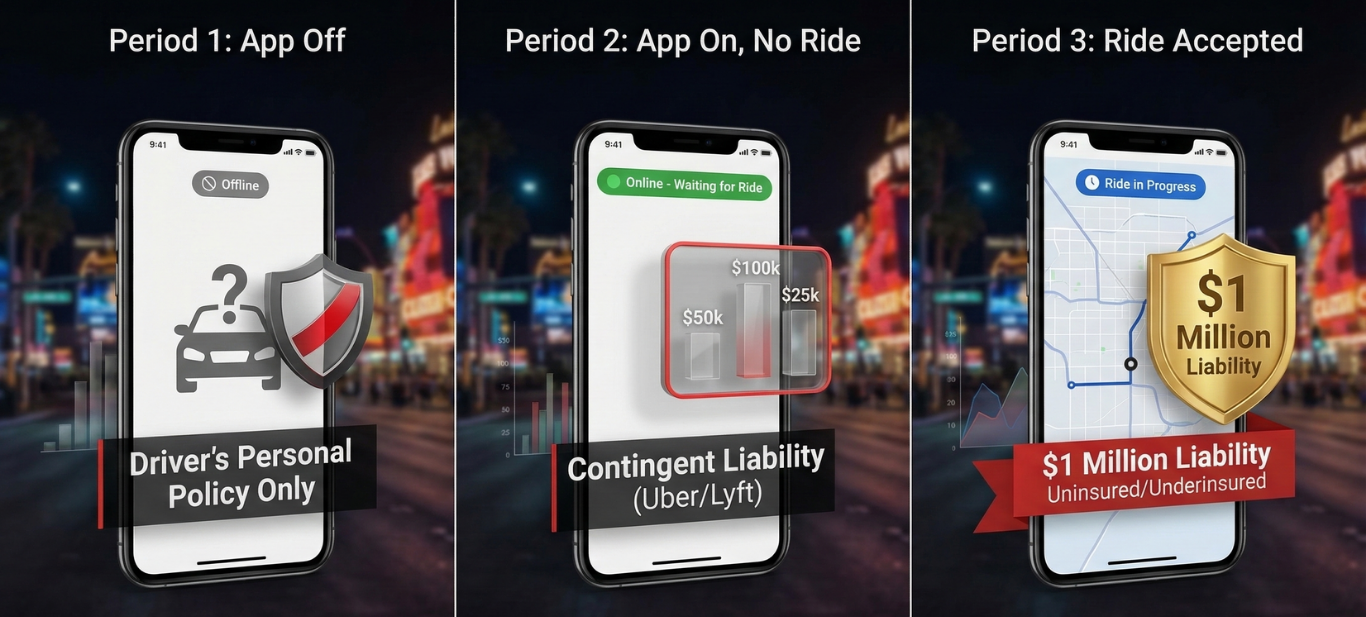
In a Las Vegas rideshare accident, which insurance policy pays depends on the driver’s app status at the time of the crash. Nevada law (NRS 706A) defines three coverage periods:
- Period 1 – App Off: Only the driver’s personal auto policy applies. Uber and Lyft provide no coverage.
- Period 2 – App On, No Ride Accepted: Uber and Lyft provide contingent liability coverage — $50,000 per person, $100,000 per accident, and $25,000 for property damage — but only if the driver’s personal policy first denies the claim.
- Period 3 – Ride Accepted Through Trip End: Full $1 million liability coverage and uninsured/underinsured motorist coverage activate through Uber or Lyft.
The period that applies to your accident determines everything about your claim. Insurers regularly dispute period classification to limit what they pay out. If an insurer is disputing your coverage period, talk to a Las Vegas car accident lawyer before responding.
Nevada Law and the Three-Period Rideshare Coverage Structure
Nevada classifies Uber and Lyft as Transportation Network Companies (TNCs) under NRS Chapter 706A. That classification matters because it means these companies are not treated like standard auto insurers. State law requires TNCs to maintain specific insurance minimums at each phase of a driver’s trip, and those minimums change depending on what the driver is doing at the time of the accident.
The “period” concept exists to separate when a driver is acting as a private citizen from when they are operating as a commercial carrier. A driver sitting at home with the app closed is legally no different from any other motorist on the road. The moment they log in and begin accepting trips, different rules and different insurance obligations apply.
This is why rideshare accidents are legally more complex than standard two-car collisions in Las Vegas. Two insurance systems can overlap, conflict, or leave gaps depending on the exact moment of impact. In our experience, most clients don’t realize that Period 1 accidents may have zero TNC coverage, and the adjuster handling your claim will never volunteer that information.
Period 1 — App Is Off: Only Personal Insurance Applies
If the driver’s app is completely offline at the time of your accident, Uber and Lyft bear zero legal responsibility. The driver is treated as a private motorist under Nevada law. Your only path for recovery is through that driver’s personal auto insurance policy.
Uber and Lyft explicitly exclude Period 1 from their commercial coverage in their policy documents. There is no fallback TNC policy to pursue. If the driver carries insufficient personal coverage or none at all, you may be looking at an uninsured motorist claim through your own policy.
One complication comes up more often than you might expect: drivers who misrepresent their app status after a crash. A driver may claim the app was off to avoid involving their rideshare company. Digital trip logs and GPS data recorded by the app can prove exactly what the app was doing at the moment of impact. Getting access to those records quickly is one area where having an attorney makes a real difference.
| Party | Coverage Source |
|---|---|
| TNC (Uber / Lyft) | None — app is off |
| Driver | Personal auto insurance policy only |
| Victim (if driver uninsured) | Your own UM/UIM coverage may apply |
Period 2 — App On, No Ride Yet: The Dangerous Coverage Gap
Period 2 begins the moment a driver logs into the Uber or Lyft app and ends when they accept a ride request. The driver appears to be “working,” but the coverage available during this window is limited and comes with a significant catch.
During Period 2, Uber and Lyft provide contingent liability coverage under NRS 706A.230. The limits are $50,000 per person, $100,000 per accident, and $25,000 for property damage. “Contingent” means the TNC policy only activates if the driver’s personal auto insurer first denies the claim or lacks sufficient coverage to pay it.
Here is where the real danger lies. Many personal auto policies now include rideshare exclusions. If the driver’s personal insurer denies the claim because the driver was logged into a rideshare app at the time of the crash, you are left fighting to activate the TNC’s contingent policy. Some drivers carry Nevada rideshare gap insurance riders to bridge this exposure, but many do not. That gap can leave you facing an underinsured driver scenario with no clean path to full recovery.
We handled a case where a client was rear-ended on I-15 by a driver in Period 2. The driver’s personal insurer denied the claim outright, citing a rideshare exclusion in the policy. We had to compel Uber’s contingent policy to respond to a process that took documentation, legal pressure, and time our client would not have had going it alone.
Dealing with a Period 2 dispute? Our Las Vegas Car Accident Lawyer knows how to compel TNC coverage when insurers push back.
Period 3 — Ride Accepted Through Drop-Off: Full $1 Million Coverage
Period 3 begins the moment a driver accepts a ride request and remains active until the passenger is dropped off. This is the strongest coverage window in a rideshare trip. Once Period 3 activates, Uber and Lyft are required under NRS 706A.230(2) to carry $1,000,000 in third-party liability coverage.
Uninsured and underinsured motorist (UM/UIM) coverage also activates during Period 3. This matters when another driver caused your crash; if that driver carries no insurance or insufficient coverage, the TNC’s UM/UIM policy can still compensate you. Contingent comprehensive and collision coverage may also apply to the driver’s own vehicle during this period.
One detail that surprises many clients: the $1 million figure is an aggregate liability limit. It does not mean every injured person automatically receives that full amount. When multiple passengers or bystanders file claims from the same accident, the $1 million is divided among all claimants. A serious crash with several injured parties can significantly reduce what any one person recovers.
| Period | App Status | TNC Coverage Level | Key Limitation |
|---|---|---|---|
| Period 1 | App Off | None | Driver's personal policy only |
| Period 2 | App On, No Ride Accepted | Contingent — $50K/$100K/$25K | Subordinate to personal policy; exclusions create gaps |
| Period 3 | Ride Accepted Through Drop-Off | $1M liability + UM/UIM | Aggregate limit shared among all claimants |
When Multiple Parties Share Liability in a Rideshare Accident
Rideshare accidents in Las Vegas rarely involve just one responsible party. A crash may implicate the TNC driver, another motorist, and, in some cases, a road defect maintained by NDOT or Clark County. When multiple parties share fault, multiple insurance companies enter the picture, and each one will work to limit its own exposure. Nevada follows a comparative negligence standard under NRS 41.141. Even if you share some portion of fault for the accident, you can still recover compensation. Your total recovery is reduced by your percentage of fault, but you are not barred from collecting unless you are found more than 50% responsible. This rule protects Las Vegas accident victims who may have played a minor role in what happened.
One of the most common tactics we see from TNC insurers is period misclassification.
Uber or Lyft may argue your accident occurred during Period 2 instead of Period 3 to cut their liability from $1 million down to $50,000 per person. Accurate period classification is one of the most contested issues in rideshare litigation and one of the most consequential.
When multiple carriers are involved, subrogation rights add another layer of complexity. Each insurer may attempt to push liability onto another company to avoid paying. Without someone managing that process, victims can find themselves caught between competing insurers with no resolution in sight.
- Document the driver’s app status in your police report notes immediately after the crash.
- Identify all involved vehicles and request insurance information from every driver.
- Note any road conditions, signals, or signage that may indicate a municipal liability.
- Preserve all communications from every insurer. Do not respond without legal guidance.
- Request a copy of the LVMPD accident report as soon as it becomes available.
What to Do Immediately After a Las Vegas Rideshare Accident
The steps you take in the first 48 hours after a Las Vegas rideshare accident directly affect how much compensation you can recover. Insurers look for gaps in documentation and treatment to reduce or deny claims. Acting quickly and carefully protects your position before anyone else can shape the record.
Screenshot the app immediately
Open Uber or Lyft and capture your trip receipt, driver information, and ride status timestamp. This is some of the most important evidence in your case, and it can disappear quickly.
Call 911 and request an LVMPD report.
When officers arrive, make sure the rideshare context is noted in the report. The driver’s app status and company affiliation should appear in the official record.
Seek medical attention within 24–48 hours.
Nevada insurers use gaps in medical treatment as grounds to reduce your claim. Even if your injuries feel minor, get evaluated at a facility like UMC or Sunrise Hospital and follow through with recommended care.
Do not give recorded statements.
Uber and Lyft both have dedicated accident response teams. Their goal is claim mitigation, not fair compensation. Do not speak with any TNC insurer or third-party adjuster before consulting an attorney.
Preserve all communications from Uber and Lyft support.
Save every message, email, and in-app notification. These records can become critical evidence as your case develops.
One detail most clients never consider: Uber’s system generates an internal incident report the moment a crash is flagged in the app. That document can directly contradict what the driver told police at the scene. We subpoena it early, and it often changes the course of a case. Which insurance period applies to your accident determines everything the company is responsible for, the coverage limits available, and how hard the insurer will fight to pay as little as possible. Uber and Lyft are not neutral parties in this process. They have legal teams and internal systems designed to protect their bottom line from the moment a crash is reported. Period classification, multi-party liability, and insurer bad faith are not issues most people are equipped to handle alone. An experienced Las Vegas car accident lawyer knows how to establish the correct coverage period, compel TNC policies to respond, and push back when insurers misrepresent what they owe you. Don’t let an insurer misclassify your accident. Contact our Las Vegas car accident lawyer today.
Get A Consultation Today
Fill out the info below and we’ll give you a call.
