
How Nevada’s Comparative Negligence Law Affects Your Car Accident Payout in Las Vegas
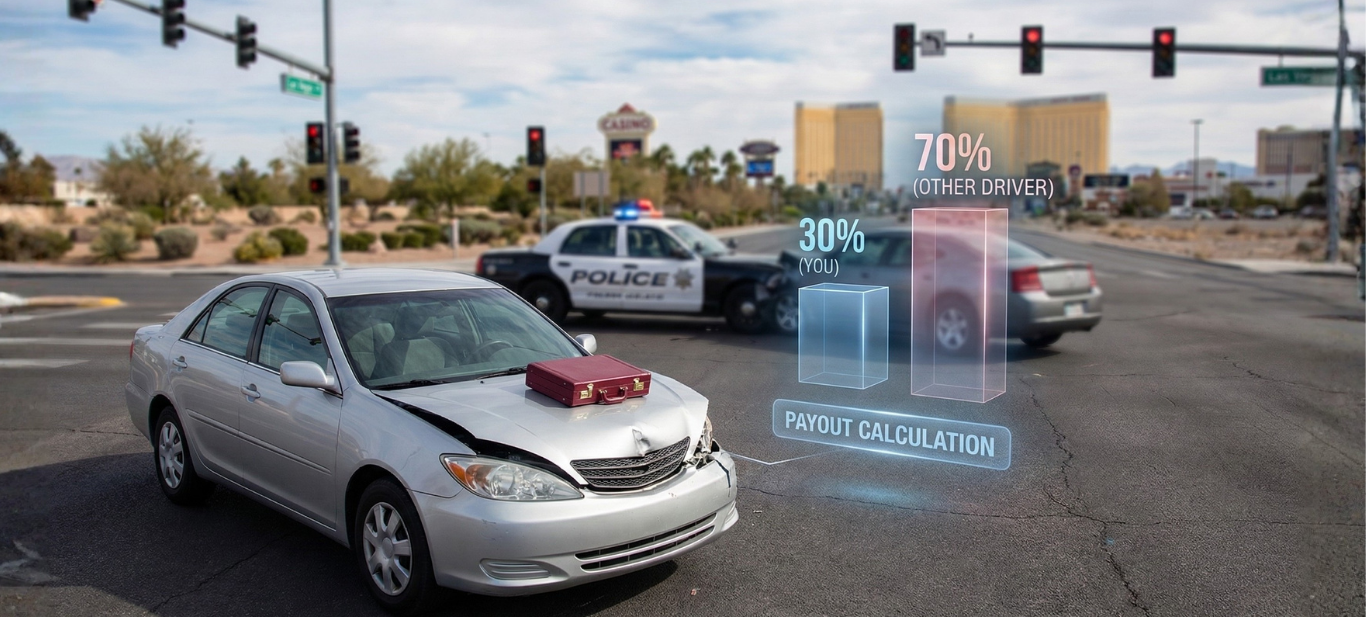
You ran a yellow light. The other driver was texting. The police report splits the blame 30% yours, 70% theirs. Does that mean you walk away with nothing? In Nevada, the answer depends on one law most accident victims have never heard of. Nevada’s comparative negligence law affects your car accident payout in a very specific way, and a single percentage point can be the difference between a full recovery and zero compensation. Nevada uses a “modified comparative fault” system under NRS 41.141. That means your payout is reduced by your share of fault, but only up to a point. Cross that line, and Nevada law bars you from collecting anything at all.

How does Nevada’s comparative negligence law affect a car accident payout?
Under Nevada’s modified comparative fault rule (NRS 41.141), your payout is reduced by your percentage of fault but only if your share is 50% or less. If you are found 51% or more at fault, Nevada law bars you from collecting any compensation at all.
Example: You are awarded $100,000 in damages but found 30% at fault. Your net payout drops to $70,000.
The hard cutoff: Reach 51% fault, and you recover nothing regardless of the other driver’s role in the crash.
Fault percentages are not final when an adjuster first sets them. An experienced Las Vegas car accident lawyer can challenge that number and protect your payout.
Free case evaluation with a Las Vegas car accident lawyer.
What Is Nevada’s Comparative Negligence Law?
Nevada follows a modified comparative fault rule. That means if you share some blame for a car accident, you can still recover compensation as long as your share of fault stays at 50% or below. This is different from “contributory negligence,” which some states still use. Under contributory negligence, any fault on your part, even 1%, wipes out your entire claim. Nevada moved away from that all-or-nothing standard to give more injured people a path to recovery.
The controlling law is NRS 41.141. It sets a two-part test for any accident claim. First, were you at fault at all? Second, was your share of fault 50% or less? If both answers point toward a partial share under that threshold, your claim survives, reduced by your percentage, but not eliminated.
Many clients come to us after an accident, convinced they have no case because they were “partly at fault.” That assumption costs people real money. The 50% threshold is what separates a reduced payout from no payout, and that line matters more than most people realize.
Knowing the definition is one thing, but the rule that actually makes or breaks your case comes down to a single percentage point. Here’s why.
The 51% Bar Rule: Nevada’s Hard Cutoff
Nevada’s 51% bar rule is straightforward. At exactly 50% fault, you recover. At 51% fault, you recover nothing. That one percentage point does not cost you 1% of your damages; it costs you everything. This is what makes Nevada a “modified” comparative fault state. In a pure comparative fault state like California, even a plaintiff found 99% at fault can recover 1% of their damages. Nevada draws a hard line. Once you cross 50%, the door closes completely.
Here is how the math looks across different fault scenarios:
| Fault % Assigned to You | Damages Awarded | Net Recovery | Do You Recover? |
|---|---|---|---|
| 10% | $80,000 | $72,000 | Yes |
| 30% | $100,000 | $70,000 | Yes |
| 50% | $200,000 | $100,000 | Yes |
| 51% | $200,000 | $0 | No |
| 60% | $150,000 | $0 | No |
Consider a T-bone collision at a Las Vegas intersection. The other driver ran a red light. But you were speeding. An adjuster assigns you 51% of the fault. Under Nevada law, that single percentage point eliminates your entire claim even though the other driver caused the collision.
One percent can cost you everything. The fault percentage an adjuster assigns is not final.
Those inputs sound straightforward, but what actually determines where your percentage lands? The next section breaks down exactly how fault is calculated in Nevada car accident cases.
How Fault Percentages Are Calculated in Nevada Car Accident Cases
Fault percentages do not appear out of thin air. They are built from evidence, and the strength of that evidence determines where your number lands.
Four primary inputs drive fault assignments in Nevada car accident cases:
- Police reports — The responding officer’s narrative and diagram carry significant weight with insurers and courts.
- Witness statements — Bystanders and other drivers can corroborate or contradict each party’s account.
- Traffic camera and dashcam footage — Visual evidence is often the most persuasive input in disputed fault cases.
- Accident reconstruction experts — In complex crashes, specialists analyze vehicle damage, skid marks, and road conditions to establish what happened and when.
Insurance adjusters review this evidence and assign an initial percentage of fault. That number feels official, but it is not final. Adjusters work for the insurance company, not for you. Their job is to protect their client’s payout, and that often means pushing your percentage as high as possible. Nevada traffic statutes also shape fault determinations directly. Right-of-way violations fall under NRS 484B. Texting or distracted driving is prohibited under NRS 484B.165. Speed violations, failure to yield, and improper lane changes all factor in. On top of that, your own contributory behaviors, failure to wear a seatbelt, jaywalking, or any prior impairment, can be used to raise your assigned percentage. We have seen adjusters assign 40% fault to a rear-end victim. That kind of inflation is not unusual. Document everything at the scene immediately: photos, witness contact information, and your own account of events before memory fades.
Have questions about your case? See our Google reviews and get directions to our Las Vegas office. Those inputs only tell part of the story. Their real impact becomes clear when you see how they play out in actual Las Vegas accident scenarios.
Real Las Vegas Examples: How Shared Fault Changes the Math
Abstract rules become real when you see the dollar impact. These three scenarios show how fault percentages play out in Las Vegas car accident cases.
Scenario A: Low Shared Fault (I-15 Rear-End Collision)
A driver is rear-ended on I-15 near the Tropicana interchange. The plaintiff made a sudden lane change just before impact. The adjuster assigns 10% fault to the plaintiff. A jury awards $80,000 in damages. After the 10% reduction, the plaintiff recovers $72,000. The case was worth pursuing.
Scenario B: Near the Bar (Las Vegas Strip Intersection)
A T-bone collision occurs at a busy Strip intersection. The adjuster initially assigns the plaintiff 52% fault, one point above the bar. Under Nevada law, that means zero recovery on $200,000 in damages. An attorney obtained surveillance footage from a nearby casino and challenged the adjuster’s methodology. Fault was reduced to 45%. The plaintiff recovered $110,000. Without legal representation, this case paid nothing.
Scenario C: Above the Bar (Red Light Violation)
A plaintiff runs a red light and is struck by another driver. The investigation finds the plaintiff 60% at fault. Nevada’s 51% bar applies. Despite the other driver bearing 40% of the responsibility, the plaintiff recovers nothing.
Here is how those outcomes compare side by side:
| Scenario | Fault % | Damages Awarded | Net Recovery |
|---|---|---|---|
| A: I-15 Rear-End | 10% | $80,000 | $72,000 |
| B: Strip Intersection | 45% (reduced from 52%) | $200,000 | $110,000 |
| C: Red Light | 60% | $150,000 | $0 |
These scenarios are illustrative. They are not guarantees of any specific outcome in your case. Every accident involves different facts, evidence, and insurance dynamics. What every example above has in common: the final fault percentage was not the first number on the table. It was contested. That is where legal representation changes everything.
Results like these start with a free case evaluation. Talk to a Las Vegas Car Accident Lawyer today.
How a Las Vegas Car Accident Lawyer Can Protect Your Fault Percentage
Fault percentages are argued, not simply handed down. The number an adjuster puts on paper on day one is a starting point, not a verdict. An attorney’s core job in a comparative fault case is to build the evidentiary record that brings your percentage down.
That work is time-sensitive. Traffic camera footage in Las Vegas is typically overwritten within 30 to 72 hours. Casino surveillance footage along the Strip and surrounding corridors can disappear just as fast. The moment after an accident is when the evidence that could protect your claim is most at risk of being lost. We move quickly to preserve the camera footage, witness accounts, and physical evidence at the scene before it is gone.
Where the facts are disputed, we bring in accident reconstruction experts. These specialists can challenge an adjuster’s methodology point by point, using vehicle damage patterns, road conditions, and traffic data to reframe what actually happened.
Nevada’s statute of limitations gives you two years from the date of your accident to file a personal injury lawsuit under NRS 11.190. That window sounds long. But delay weakens your evidence, makes witnesses harder to locate, and gives the other side more time to build their fault argument against you. Acting early protects your position.
One client came to us after an adjuster assigned 55% fault following a sideswipe on Las Vegas Boulevard. That number put the entire claim on the wrong side of Nevada’s 51% bar. After obtaining surveillance footage from a nearby casino, we reduced that percentage to 28%. The case that started at zero recovered a significant settlement.
Our representation works on a contingency fee basis. You pay nothing unless we recover for you. The cost of legal help is not a barrier, and given what a single percentage point can cost you under Nevada law, waiting is the only decision that carries real risk.
Don’t let an inflated fault percentage take your recovery. Get a consultation today!
Get A Consultation Today
Fill out the info below and we’ll give you a call.
