
Steps to Take After a Car Accident in Las Vegas (And What Not to Do If You Want Full Compensation)
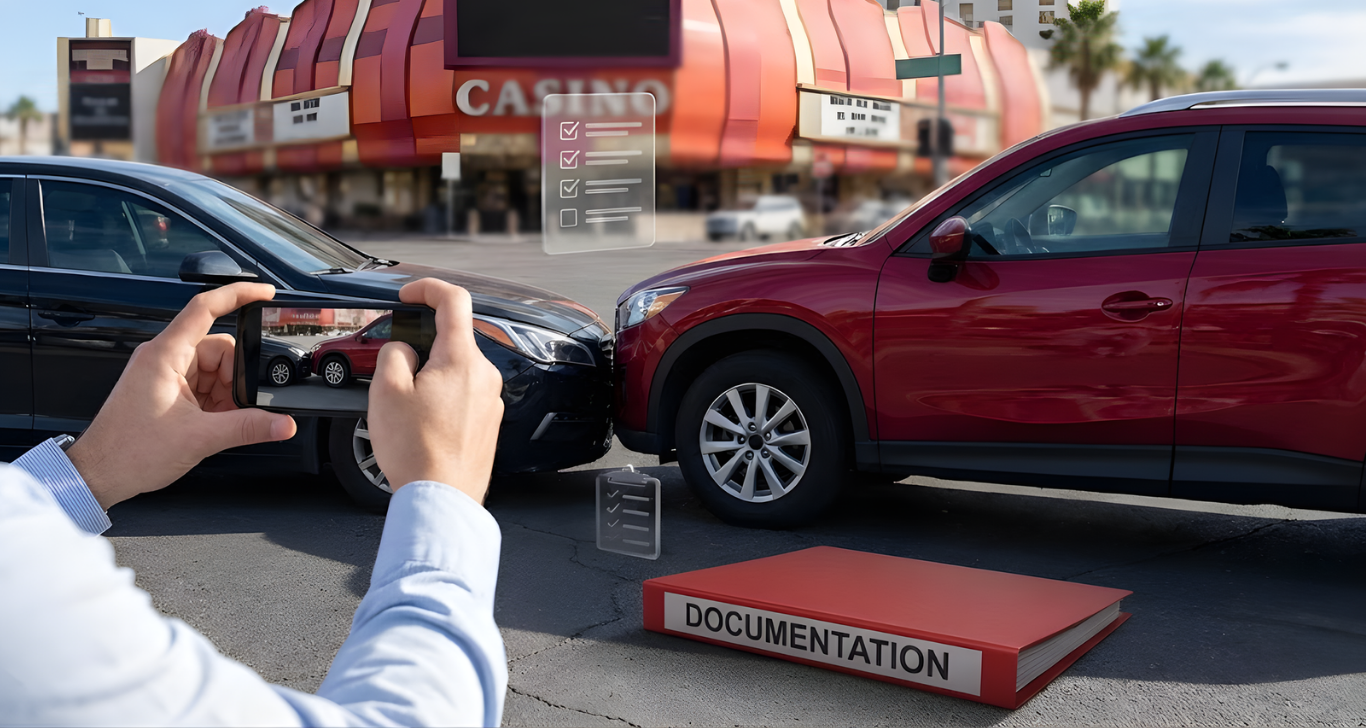
After a car accident in Las Vegas, the steps you take in the first few minutes protect both your health and your right to compensation. Nevada law sets specific requirements at the scene, and what you say to other drivers, police, and insurers can either support your claim or quietly reduce it.
Las Vegas Metro sees a disproportionate share of Nevada’s injury crashes every year. In those first chaotic moments, most people don’t realize they’re already making decisions that affect their case.
This guide covers the exact steps to take after a car accident in Las Vegas, from the scene through your first contact with an insurance adjuster. We’ll explain what Nevada law requires, how to document the scene, which phrases hurt injury properly claims the most, and when calling a Las Vegas car accident lawyer is the right move.
What Are the Steps to Take After a Car Accident in Las Vegas?
The steps to take after a car accident in Las Vegas are:
- Check for injuries — Call 911 immediately, even for minor accidents
- Move to safety — Turn on hazard lights; move your vehicle only if it is unsafe to stay
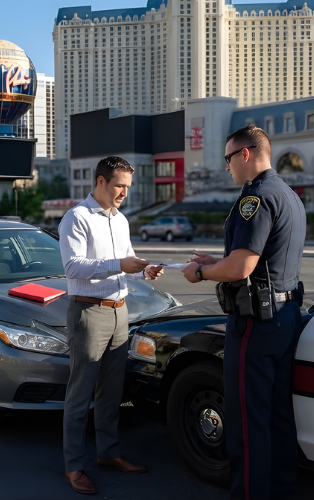
- Wait for Metro Police — Nevada law requires a police report for any accident involving injury or property damage over $750 (NRS 484E.070)
- Exchange information — Get the other driver’s name, license number, insurance carrier, policy number, and license plate
- Document the scene — Photograph all vehicles, damage, road conditions, street signs, and skid marks.
- Get witness information — Names and phone numbers of anyone who saw the crash.
- Seek medical care — Go even if you feel fine; symptoms can appear 24–72 hours later.
- Notify your insurer — Report the accident, but do not give a recorded statement without legal advice.
- Consult a Las Vegas car accident lawyer. Do this before accepting any settlement offer
What Nevada Law Actually Requires You to Do at the Scene
Nevada law is clear about what every driver must do after a car accident. Under NRS 484E.010 through NRS 484E.070, you must stop your vehicle, check for injuries, and exchange information with the other driver. If anyone is injured or property damage exceeds $750, you must also report the crash to Metro Police.
Leaving the scene is a criminal offense in Nevada. Penalties get worse if someone was hurt. A hit-and-run involving serious injury or death can lead to felony charges. Even walking away briefly without telling the police first can cause legal problems.
Many drivers don’t know this: Nevada law requires you to share your information. It does not require you to admit fault. You don’t have to say who caused the crash or apologize. Those words carry legal weight under Nevada’s fault rules and can reduce your compensation later.
If the other driver flees or has no insurance, call Metro Police right away. Write down the plate number, vehicle color, and direction they went. That information goes into your official report and supports any uninsured motorist claim you may need to file.
| What Nevada Law Requires | What Nevada Law Does NOT Require You to Say |
|---|---|
| Stop your vehicle at or near the scene | Who caused the accident |
| Check for injuries and render aid | How fast were you going |
| Exchange name, license, registration, and insurance | Whether you were distracted |
| Report to Metro Police if injury or damage exceeds $750 | Any apology or expression of fault |
| Remain at the scene until the police release you | A recorded statement to any insurer at the scene |
In our experience handling Las Vegas accident cases, one of the most common mistakes we see is clients moving their vehicle to what they believe is a safer location without first notifying the police. That brief gap in scene presence can be framed as leaving the scene, even when that was never the intent. If you need to move, tell the 911 dispatcher before you do.
The First 10 Minutes: Your Step-by-Step Scene Checklist
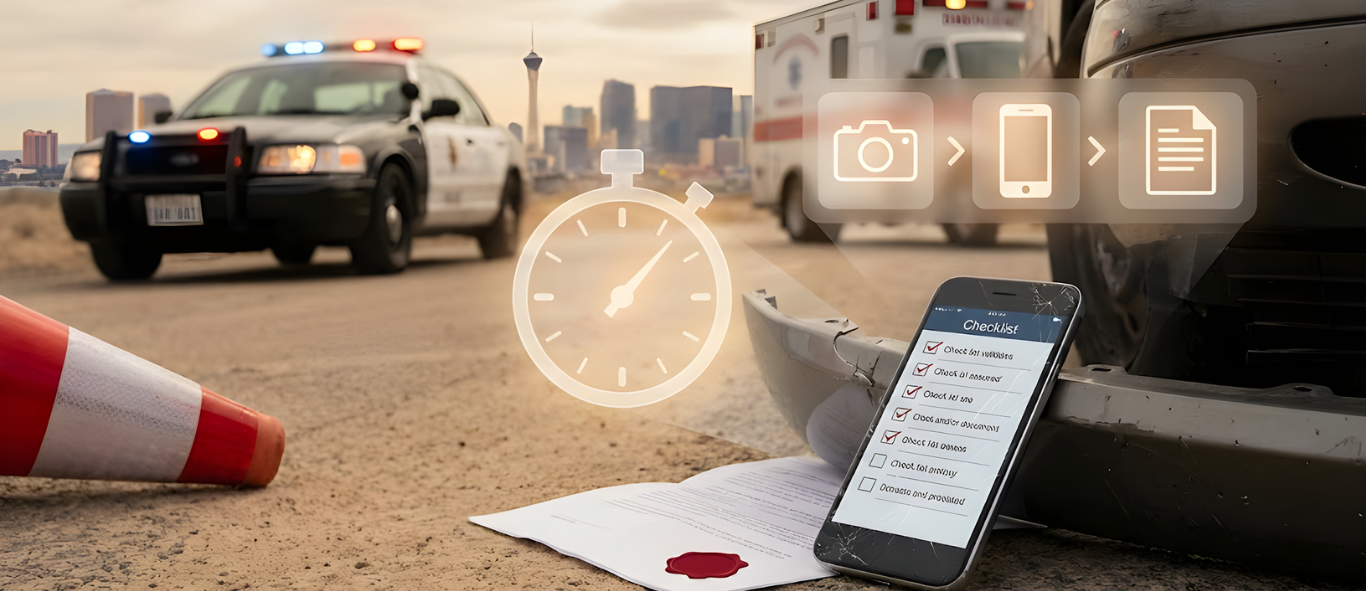
Nevada law tells you what you must do, but the order and speed at which you do it matter just as much. The first 10 minutes after a Las Vegas car accident are when the most useful evidence is available and when the most damaging mistakes occur. Follow this sequence to protect yourself.
Priority sequence:
- Check yourself and passengers for injuries before anything else
- Call 911 — request police and medical if anyone is hurt
- Turn on hazard lights and stay visible to other traffic
- Move your vehicle only if it is blocking traffic or unsafe to stay. Tell the 911 dispatcher first
What to photograph at the scene:
- All four sides of every vehicle involved
- License plates on all vehicles
- The position of vehicles before they are moved
- Skid marks, debris, and road damage
- Street signs, signals, and intersection markings
- Weather conditions and lighting
- Any visible injuries, photograph carefully and factually
- Your own vehicle’s interior if airbags are deployed
What to say to the other driver:
Limit conversation to the information exchange only. Provide your name, license number, insurance carrier, and policy number. Do not discuss the accident, assign blame, or speculate about what happened.
What to say to the police:
Give a factual account of what you observed. Describe what you saw and did — not what you think caused the crash. Avoid estimating speed or making statements about fault. If you are unsure about something, say so.
Why witness information matters:
Bystander accounts are often the deciding factor in disputed Nevada claims. A witness with no connection to either driver carries significant weight with insurers and in court. Get full names and phone numbers before witnesses leave the scene.
What Information to Exchange After a Car Accident in Las Vegas
After a car accident in Las Vegas, exchanging the right information at the scene protects your ability to file a claim. Missing even one item can delay your case or give an insurer a reason to dispute coverage. Collect everything on this list before you leave the scene.
7 Things to Exchange After a Las Vegas Car Accident:
- Full legal name of every driver involved
- Driver’s license number, ask to see the physical license
- Vehicle registration confirms ownership and matches the plate
- Insurance company name and policy number, photograph the insurance card
- License plate number: photograph the plate directly, do not rely on memory
- Phone number, not legally required, but important for follow-up
- Employer name and contact required if the vehicle is a commercial or a company car
If the other driver refuses to provide information or leaves the scene, do not follow them. Call Metro Police immediately and report everything you observed: plate number, vehicle description, and direction of travel. That information goes into your official report and supports any claim you file.
Rideshare accidents require additional documentation. If an Uber or Lyft driver hit you, capture the app trip ID and the driver’s in-app profile, not just their personal auto insurance. Rideshare companies carry separate commercial policies that apply depending on the driver’s status at the time of the crash.
For commercial vehicle accidents, collect the trucking company name, the DOT number displayed on the vehicle, and the driver’s employer information. Federal Motor Carrier Safety Administration (FMCSA) regulations require commercial carriers to maintain insurance and operational records, which can quickly become relevant in a truck accident claim.
Getting Medical Care After a Las Vegas Car Accident (Even When You Feel Fine)
See a doctor the same day as your accident, even if you feel okay. Adrenaline released during a crash masks pain. That adrenaline hides pain. Soft tissue injuries, whiplash, and brain injury symptoms often show up 24 to 72 hours after impact.
Nevada insurers treat gaps in medical treatment as evidence that your injuries were minor or unrelated to the accident. Waiting to get care gives insurers a reason to reduce your claim. The longer the gap between your accident and your first doctor visit, the easier it is for an adjuster to argue your injuries came from something else. That gap in your medical record is one of the most common ways Nevada insurers lower or deny injury claims.
| Seek Care Immediately If... | Still See a Doctor Within 24 Hours If... |
|---|---|
| You lost consciousness at any point | You feel stiff or sore but not severely hurt |
| You have a headache, confusion, or vision changes | You have minor neck or back discomfort |
| You cannot move a limb or feel numbness | You felt fine at the scene, but pain is developing |
| You have visible wounds or suspected broken bones | You are unsure whether your symptoms are accident-related |
| A passenger — especially a child — shows any distress | You want a documented baseline for your claim |
The choice between an emergency room, urgent care, or your primary care doctor also matters to your claim. An ER visit for a serious mechanism of injury signals an appropriate medical response. Choosing to wait for a regular appointment signals that you did not consider the situation urgent. When in doubt, go to the nearest facility the same day.
Start a symptom journal the day of the accident. Write down what hurts, when symptoms appear or worsen, and how your injuries affect daily activities. Save every medical bill, prescription receipt, and appointment summary. Track any missed work and lost income from day one. That documentation becomes the foundation of your economic damages claim.
Deciding to wait and see how you feel is the single most expensive decision most Las Vegas accident victims make. By the time symptoms are undeniable, the treatment gap already exists, and insurers will use it.
When Should You Hire a Lawyer After a Car Accident in Las Vegas?
Hiring a Las Vegas car accident lawyer sooner protects more of your claim. Nevada’s statute of limitations is two years under NRS 11.190, but surveillance footage is overwritten, witnesses disappear, and evidence degrades fast. The window between your accident and the first settlement offer is when legal representation matters most.
You probably need a lawyer if:
- You sustained any injury requiring medical care
- The other driver is disputing fault
- A commercial, rideshare, or government vehicle was involved
- Your insurer is delaying or denying your claim
- You already received a settlement offer
We handle cases on a contingency fee basis, with no upfront cost, no fee unless we recover for you.
Get A Consultation Today
Fill out the info below and we’ll give you a call.