
How to File a Diminished Value Claim in Las Vegas: A Step-by-Step Guide

Most drivers in Las Vegas never realize their car is worth less after an accident — even after perfect repairs. The at-fault driver’s insurer is required to compensate you for the lost resale value. But insurers rarely bring it up on their own. That difference in market value is called diminished value, and it can add up to thousands of dollars you’re legally owed.
You got your car back from the body shop. It looks the same as before. But the moment a buyer pulls a Carfax report, that accident history drops your trade-in offer by $2,000, $4,000, or more. That’s real money — and in Nevada, you have the right to claim it.
This guide explains exactly how to file a diminished value claim in Las Vegas, from gathering the right documents to negotiating with Nevada insurers — so you can recover every dollar you’re owed.
We’ll cover who qualifies, what evidence you need, the step-by-step filing process, and how to push back when an insurer lowballs you. We’ll also explain when it makes sense to bring in a Las Vegas attorney.
How Do I File a Diminished Value Claim in Las Vegas?
To file a diminished value claim in Las Vegas, follow these steps:
- Confirm eligibility — You must not be at fault. Nevada follows modified comparative negligence (NRS 41.141). You can only claim if you are less than 51% responsible for the accident.
- Get a professional appraisal — Hire a certified diminished value appraiser. They will document your car’s pre- and post-accident market value.
- Gather your documentation — Collect the police report, repair records, the insurer’s settlement, and your appraisal report.
- Submit a formal demand letter — Send a written demand to the at-fault driver’s insurer. Cite Nevada law and your appraisal amount.
- Negotiate or escalate — If the insurer disputes or underpays, you can negotiate, file a complaint with the Nevada Division of Insurance, or consult an attorney.
Nevada’s statute of limitations for property damage claims is three years from the date of the accident (NRS 11.190). Do not let that window close before you act.
What Is Diminished Value and Why Nevada Insurers Won’t Tell You About It
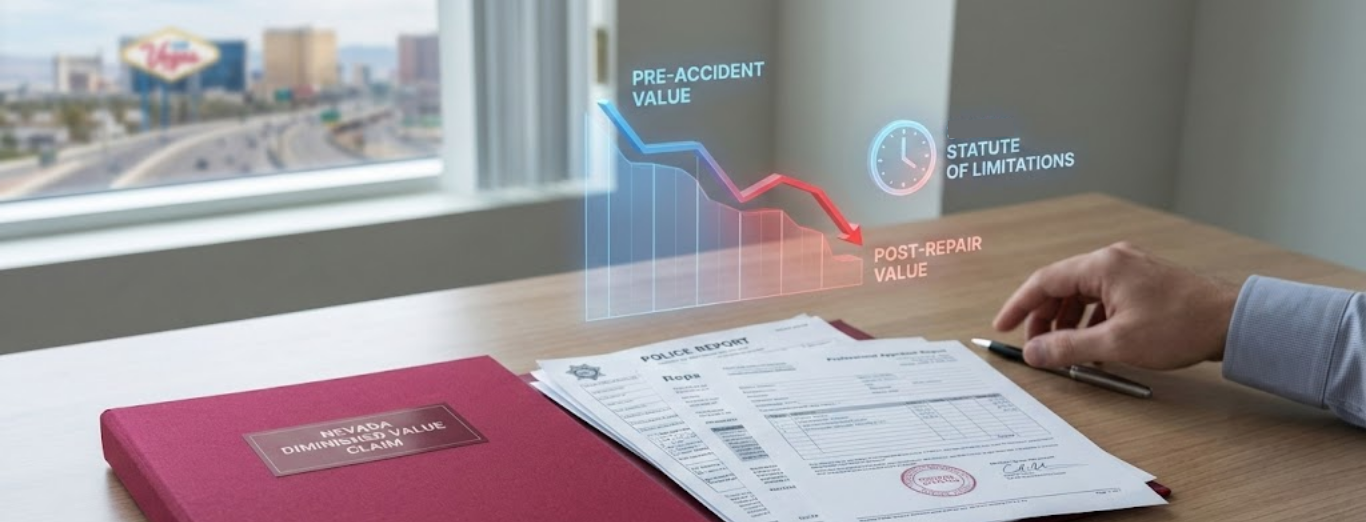
After an accident, your car may look and drive exactly as it did before. But its market value tells a different story. Diminished value is the gap between what your car was worth before the accident and what it’s worth after — even with complete, high-quality repairs. That gap is real, and in Nevada, you can recover it from the at-fault driver’s insurer.
There are three types of diminished value. The most common is inherent diminished value — the automatic drop in resale value that comes from having an accident history, regardless of how well the car was repaired. The other two types involve poor repairs or immediate post-accident loss, but inherent diminished value is what most Las Vegas drivers are dealing with after a collision.
Nevada does not have a single statute that specifically mandates diminished value coverage. However, Nevada courts and case law support your right to recover it from an at-fault party. That legal basis is real — but it only works if you know to ask for it.
That’s the problem. Insurers have no legal obligation to tell you that this right exists. Adjusters handle your property damage claim, settle it as quickly as possible, and close the file. By the time most clients come to us, weeks have passed, and documentation is harder to pull together. Don’t wait for the insurer to bring it up; they won’t.
| What Repairs Fix | What Repairs Can't Fix (Diminished Value) |
|---|---|
| Structural damage | Accident history on Carfax or AutoCheck |
| Cosmetic damage | Buyer perception and lower offers |
| Mechanical issues | Drop in trade-in value at dealerships |
| Paint and finish | Reduced private sale price |
Do You Qualify to File a Diminished Value Claim in Nevada?
Not every accident automatically gives you a valid diminished value claim. The first thing to understand is that this is a third-party claim. You are filing against the at-fault driver’s liability insurance — not your own. If you try to file a diminished value claim with your own insurer, most policies won’t cover it.
Nevada follows a modified comparative negligence rule under NRS 41.141. To recover diminished value, you must be less than 51% at fault for the accident. If you share some fault, your recovery is reduced by your percentage. For example, if you are found 20% at fault, your diminished value award is reduced by 20%.
Your vehicle must also show a measurable drop in market value. Not every accident qualifies. Minor cosmetic damage on an older, high-mileage vehicle often results in an appraisal of $0. A certified appraiser can tell you quickly whether your car’s value actually took a hit worth pursuing.
If you drive a leased vehicle, check your lease agreement before filing. Some lessors restrict or limit your ability to recover diminished value. Nevada’s property damage statute of limitations gives you three years from the date of the accident to file your claim under NRS 11.190. One client came to us 34 months after their accident, thinking they had plenty of time. We were able to file, but pulling documentation at that stage was significantly harder. Don’t wait.

Quick Eligibility Check:
- ✅ The other driver was at fault (or mostly at fault)
- ✅ Your vehicle shows a measurable drop in market value
- ✅ You are within three years of the accident date
Step-by-Step: How to File Your Diminished Value Claim in Las Vegas
Once your documentation is in order, you’re ready to move through the actual filing process. Each step builds on the last; skipping one can weaken your position or give the insurer a reason to delay.
Step 1: Notify the at-fault driver’s insurer.
If you haven’t already opened a property damage claim, call the at-fault driver’s insurance company and do it now. Get a claim number in writing before you do anything else. This creates an official record and starts the clock on their response obligations.
Step 2: Hire an independent appraiser.
Do not use the insurer’s adjuster to value your loss. Hire a certified third-party diminished value appraiser in Las Vegas. Their report is your primary evidence and your strongest negotiating tool.
Step 3: Write and send a formal demand letter.
Your demand letter should state your appraised diminished value amount, cite Nevada law and the at-fault driver’s liability, and give the insurer a clear deadline to respond, typically 30 days. Send it via certified mail so you have proof of delivery.
Step 4: Document every communication.
Keep records of every phone call, email, and letter. Write down adjuster names, direct numbers, and the date and content of every conversation. If your claim escalates, this paper trail becomes critical evidence.
Step 5: Evaluate the insurer’s response.
Did they deny your claim, offer less than your appraisal, or go silent? Each response requires a different next move. We’ll cover exactly what to do in each scenario in the next section.
Most diminished value claims in Las Vegas resolve within 30 to 90 days when documentation is complete, and the demand letter is properly written.
How to Negotiate With Nevada Insurers and What to Do When They Push Back
Submitting a demand letter is not the end of the process; it’s the beginning of a negotiation. Most Nevada insurers will not simply accept your appraisal and cut a check. Knowing what to expect and how to respond keeps your claim moving forward.
One tactic insurers commonly use is the “17c formula,” an internal calculation method that yields low diminished-value figures. It caps payouts based on arbitrary mileage and damage percentages that have no basis in actual market data. Your independent appraisal from a certified Las Vegas appraiser is your direct counter to this formula — it reflects real market conditions, not an insurer’s internal math.
If the insurer denies your claim, lowballs your appraisal, or stops responding, you have options. You can file a formal complaint with the Nevada Division of Insurance at doi.nv.gov. Nevada’s Unfair Insurance Practices Act, under NRS Chapter 686A, prohibits insurers from unreasonably denying valid claims. If an insurer acts in bad faith, additional legal remedies may be available beyond your original claim amount.
| Insurer Says This | You Can Do This |
|---|---|
| "We don't pay diminished value claims." | Cite Nevada case law and your certified appraisal report |
| "Our adjuster valued it lower than your appraiser." | Stand firm; an independent appraisal outweighs an adjuster's estimate |
| "We need more time to review." | Set a firm written deadline; document every delay |
| "This is our final offer." | File a Division of Insurance complaint or consult an attorney |
Dealing with a lowball offer or outright denial? Our team handles diminished value negotiations daily. Speak with a Las Vegas diminished value attorney; no fee unless we win.
Should You Hire a Las Vegas Attorney for Your Diminished Value Claim?
Handling a diminished value claim on your own is possible, but it’s not always the right call. The honest answer depends on the size of your claim, how the insurer is behaving, and how much time you’re willing to invest in the process.
Some claims are straightforward enough to handle without an attorney. If your claim is under $1,500 to $2,000, the insurer is cooperative, liability is clear, and you’re confident managing the documentation and correspondence yourself, you may not need legal help. Small claims court is also an option for lower-value disputes in Nevada.
Attorney involvement makes a clear difference in other situations. If the insurer has denied your claim outright, made repeated lowball offers, or liability is being disputed, having an attorney changes the dynamic immediately. Claims over $3,000, or cases involving injuries, multiple vehicles, or commercial trucks, are sufficiently complex that professional representation typically recovers more than it costs. Most clients are surprised by how quickly we can assess whether their claim is worth pursuing. A short call often saves months of frustration navigating insurer delays alone.
Nevada personal injury and property damage attorneys work on a contingency basis. That means we get paid from your recovery; there is no upfront cost to you. A free consultation covers a review of your accident details, an honest assessment of your claim’s value, and a clear explanation of your options. You leave knowing exactly where you stand.
| Handle It Yourself | Hire an Attorney |
|---|---|
| Claim under $1,500–$2,000 | Claim over $3,000 |
| The insurer is cooperative | Insurer denies or repeatedly lowballs |
| Liability is clear and undisputed | The fault is being disputed |
| You have time to manage paperwork | Multiple damages beyond diminished value |
| Simple repair history | Severe accident or commercial vehicle involved |
If you’ve been in an accident in Las Vegas and believe your car lost value, you may be entitled to compensation you haven’t been offered. Our attorneys review diminished value claims at no cost to you. Call our Las Vegas office for a free case review, or visit the Las Vegas Diminished Value Claims page to learn more.
Get A Consultation Today
Fill out the info below and we’ll give you a call.